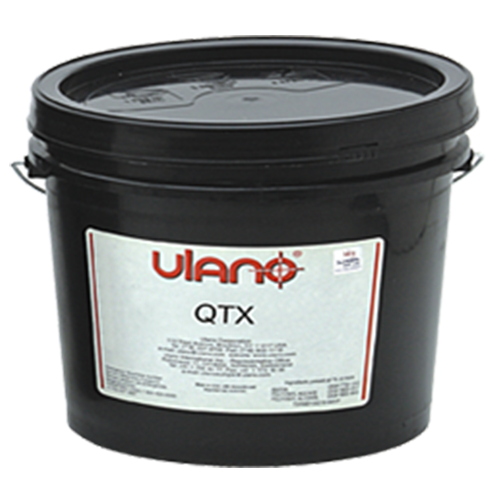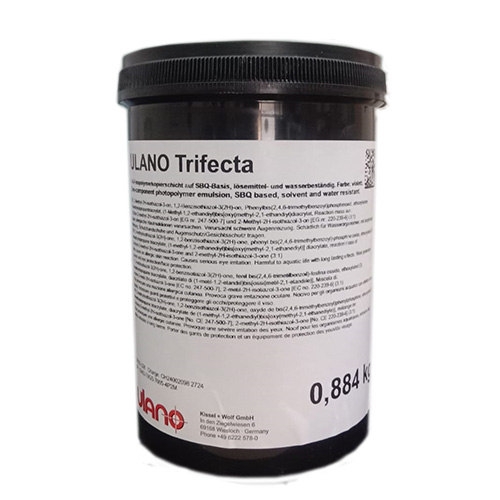

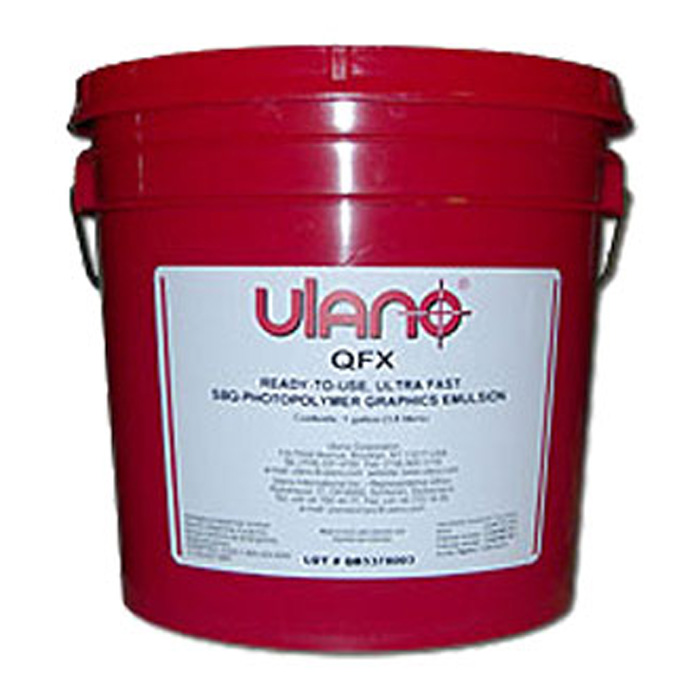
Ulano QFX Blue
Solvent resistant, one-component photopolymer emulsion
ULANO QFX Blue is used for the production of high-quality, solvent resistant stencils. High resolution and excellent mesh bridging make it suitable for for printing finest half-tones, lettering and designs (circuit boards, ceramic decals, bar-codes).
SENSITIZING
Not applicable as ready-to-use.
DEGREASING
Before coating it is recommended to clean and degrease the screen mesh to achieve reproducible coating results. Ensure proper tension of the screen mesh. Use one of our manual degreasers or degreasing concentrates for automatic units. After thorough rinsing with water and drying, the screens are ready for coating.
COATING
Coating can be done manually or by machine. The use of a coating machine is especially recommended because it achieves a reproducible coating result. If coating is done manually ensure that the mesh openings are filled from the printing side (generally 1-2). Only then begin with the emulsion build-up from the squeegee side – depending on the print job.
DRYING
The screen must be dried thoroughly before exposing to achieve the highest ink resistance. This should preferably be done in a dust-free drying-chamber with fresh-air inlet at temperatures of between 35-40°C.
EXPOSURE
The stencil is created by UV-light hardening of the non-printing stencil parts. Expose with blue actinic light at a wave length of 320-380 nm. Most suitable exposure sources are metal halide lamps. Due the many variables that determine the actual exposure time, accurate exposure times cannot be given. Optimum copying results can only be achieved by trials (i.e. step exposure). For the best ink resistance, please choose an exposure time which is as long as possible. This maximum exposure time must still allow reproduction of fine details.
RETOUCHING / BLOCKING-OUT
For retouching / blocking-out use products of our screenfiller range. Ask your distributor or ULANO for advice.
DECOATING
In general, stencils made using ULANO QFX Blue can easily be decoated. If screens are coated in advance or if printed screens are not immediately decoated, it is recommended to store them protected against UV-light or daylight to prevent post-hardening and hence additional difficulties in decoating.